How to find lost keys in the house: a room method
Knowing how to find lost keys in the house is mostly about resisting the urge to search randomly. Keys indoors are rarely gone; they are somewhere obvious that you have already walked past twice. This is a room by room order that works, the six hiding places that account for most of them, and the point at which searching stops being worth your time.
Why do keys disappear inside your own house?
Because putting keys down is not an action you remember. Memory encodes intention, not the placing of an object you were not thinking about, you remember arriving home and taking your coat off, and the keys were simply in the hand doing something else. That is why the honest answer to "where did I put them" is usually nothing at all.
The practical consequence is useful. If the placing was unconscious, the keys went somewhere convenient rather than somewhere sensible: whatever surface was nearest to the thing you were actually doing. That is what the search below is built on.
What should you do in the first two minutes?
Stop walking and retrace the last thing you did with your hands. Not the last room you were in, the last task. Unpacked shopping, answered the door, took the bins out, fed the cat, carried a mug upstairs. Keys land next to the task.
Then check yourself before you check the house. Coat pockets, including the coat you are wearing. Trouser pockets, both of them, including the pair in the wash basket. A bag's outer pocket. A surprising share of "lost" keys are on the person searching, and it takes twenty seconds to rule out.
Where do keys actually turn up?
Six places account for the overwhelming majority. Work through them in this order.
- The coat. Pockets of every coat hung by the door, not just today's. You will often find them in the pocket of the coat you wore yesterday and hung underneath.
- The handover surface. The hall table, the kitchen worktop by the kettle, the shelf by the bread bin. Look under the post and the carrier bags rather than at the surface.
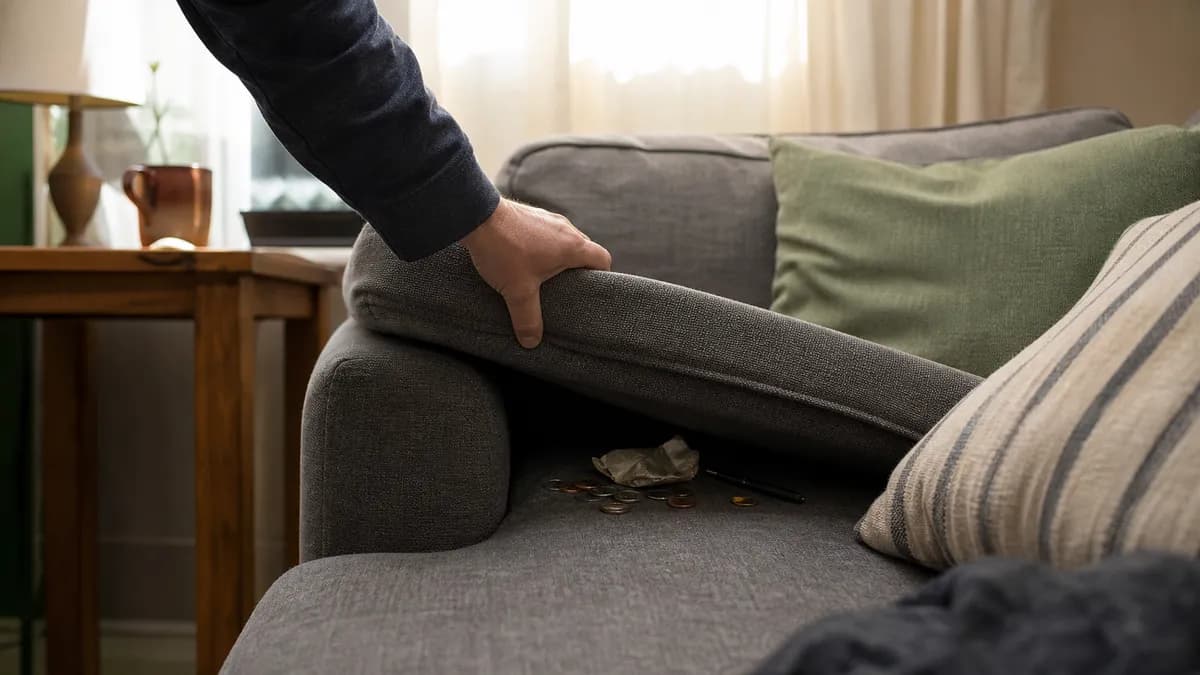
- The sofa. Down the side, under the cushions, under the sofa itself. Keys slide off a lap and vanish silently into upholstery.
- The bag. Every bag you carried in the last two days, and the lining of the one with the hole in it.
- Where they should not be. The fridge, the bathroom windowsill, the washing machine drum, the shoe rack, a child's toy box. Anywhere you were carrying something with both hands.
- Still in a lock. The front door, the back door, the shed, the car. Check the outside of the front door before you take the house apart.
How do you search a room properly?
Search by height, not by area, and do one room completely before moving on. This is the step most people skip and it is why the same room gets searched four times.
- Eye level and above. Shelves, mantelpiece, the top of the microwave. You will see either the keys or a clear surface, mark the height done and drop to the next.
- Waist to eye level. Tables, worktops, chair arms, windowsills. Lift what is on them rather than looking at them; keys hide under a newspaper perfectly.
- Floor to waist. Under furniture, in the gap behind a cushion, in shoes, in the cat bed. Use your phone torch along the floor line so that anything metal flashes back at you.
- Inside things. Drawers you opened today, the bin if you emptied a pocket into it, the laundry basket, a jacket in the wash.
After each level you either have the keys or one fewer place to look, which is what stops the search going in circles.
When should you stop searching and start ringing?
Twenty minutes of the method above is enough to say the keys are not in the rooms you use. Past that, more searching mostly produces frustration, and there are two better uses of the next ten minutes.
The first is to ring anyone who has been in the house, and anywhere you went today, before they close. The second is to work out what a replacement actually costs, because the answer changes the urgency, a Yale cylinder and a spare is one thing, a keyless car fob is another entirely, and we set out the current UK prices in the locksmith bill for lost keys.
If the keys do turn up, do one thing before you forget: decide where they live from now on. A hook by the door works because it removes the decision, and a decision is the thing that failed.
How Air Tracker helps
Every step above is a workaround for keys that cannot answer. Make them audible and the whole method collapses into one tap.
Air Tracker clips onto the ring with the key ring supplied, and from then on your iPhone can make it chime at 80–100 dB, loud enough to come through a sofa cushion, a coat hanging under three others, or a closed kitchen drawer. Within roughly 60 metres that works directly over Bluetooth, which covers the whole of an ordinary house, the garden and a car on the drive. The tag shows up in the Find My app you already have, so there is no second app and no subscription.
If the keys are not in the house at all, the map answers the question the search cannot: Apple devices passing nearby keep that last seen position current, so you learn whether to ring the pub or the school office. Turn on Notify When Left Behind and your phone flags it as you walk off, which prevents a good share of these evenings from starting.
Two honest notes. Apple hardware from iOS 14.5 upwards is required, Android will never be supported, and no Ultra Wideband arrow points the way, so sound and a pin are what you follow. The tag is IP67 rated, roughly ten grams, and its coin cell lasts a couple of years and changes out in seconds.
One box brings two tags with a key ring for each, at less than £15, posted free anywhere in the UK. put one on the set you keep losing.
Written by Item Finder Updated
More from the journal
 How to4 min read
Key finder iPhone setup: done in five minutes
A key finder iPhone setup takes about a minute in Find My. Here are the steps, the alerts worth switching on, and what to do when a tag refuses to pair.
 How to5 min read
Locked out of the house: what to do in the UK
Locked out of the house with no spare key? Work through these steps before you call anyone, then how to pick a locksmith who will not drill a lock that opens.
 In the news5 min read
The cost of losing things, and the cover you have
The true cost of losing things is rarely the price tag. A September 2026 warning about double insurance is a good reason to check what you already pay for.