How many item finders do you need around the house?
How many item finders do you need at home? For a typical household the honest answer is two to four, and the number matters far less than which objects you put them on. A tracker helps only with the thing it is attached to, so a house with six tags on the wrong six items is worse off than a house with two on the right ones. This is the rule for deciding.
How many item finders does an average household need?
Two for one adult, three or four for a family, and almost never more than six. Beyond that you are tagging things you can afford to lose, and the app becomes a list you stop reading.
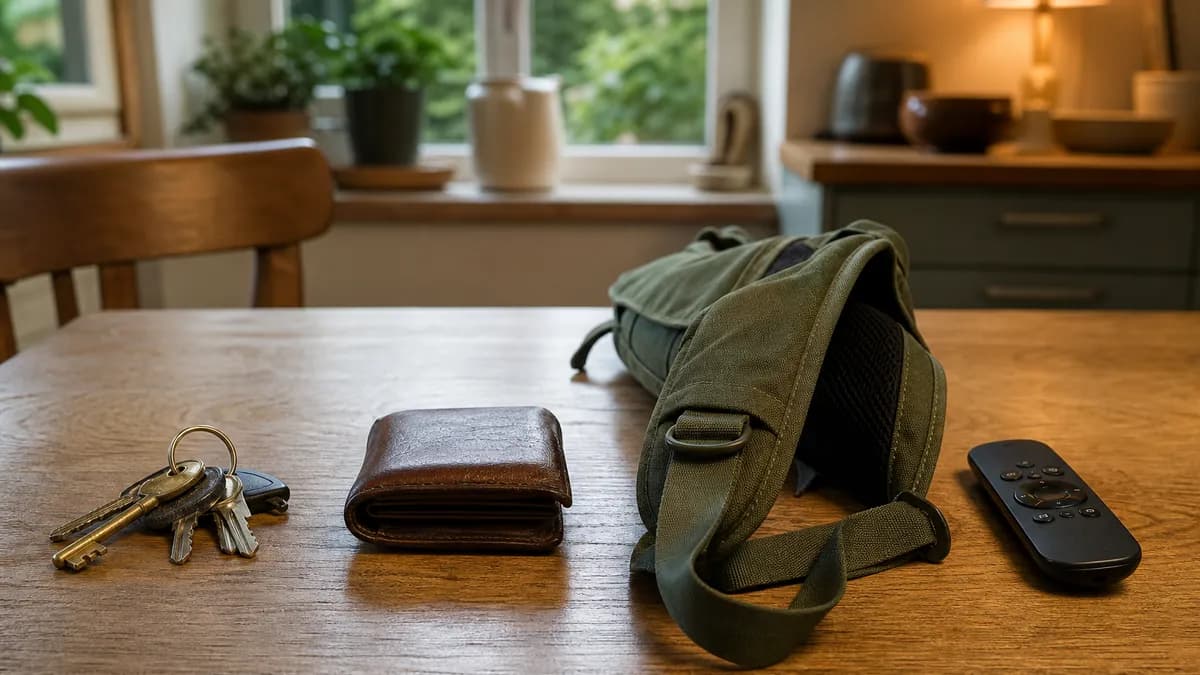
The reason the number stays low is that loss is concentrated. In any household, two or three objects account for the overwhelming majority of the searching: a set of keys, a bag or wallet, and one wildcard that differs by house, the remote, the reading glasses, a work pass. Everything else is lost occasionally and found easily.
What is the rule for deciding what to tag?
Tag the items whose absence stops you leaving the house, not the items you misplace most often. Those two lists are different, and the first one is the one that costs money.
Run the test on each candidate. If this went missing at 8.15 on a weekday morning, what happens? If the answer is "I am late" or "I cannot go", it earns a tag. If the answer is "I use the other one" or "I find it later", it does not. A TV remote fails that test and is still worth tagging in some houses, because the annoyance is daily, but be honest that it is a comfort purchase rather than a necessity.
Which items are worth a tracker and which are not?
Coin-shaped tags suit objects that have somewhere to attach and somewhere to hide. Attachment is the practical constraint people forget until the tag arrives.
| Item | Worth tagging? | The catch |
|---|---|---|
| House and car keys | Yes, first | None, this is the case it was designed for |
| Work or day bag | Yes | Put the tag inside on a zip pull, not on the outside |
| Wallet or purse | Yes, if there is a coin pocket | It will not fit a card slot at 9 mm thick |
| Suitcase | Yes | Inside the lining pocket, not on the handle |
| TV remote | Optional | Needs an adhesive pad or a pouch |
| Glasses | No | Nothing on frames will take a 10 g coin |
| Bicycle | No | Wrong tool, this is a job for a GPS unit |
| Pets | No | Range and collar safety both argue against it |
For the household objects with no keyring hole, we went through the attachment options in stopping the hunt behind the sofa.
How does the count change with more people?
Add one tag per additional adult who carries their own keys, not one per person in the house. Children rarely need a tag of their own; the bag they carry might.
Sharing changes the arithmetic in a useful way. On iOS 17 and later an item can be shared with family and friends, so a single tag on the communal keys can be rung by either adult from their own iPhone. That means a two-adult household usually needs three tags, his keys, her keys, the shared set or the bag, rather than four.
The corollary is that a tag belongs to an object, not to a person. Deciding "these are dad's trackers" is how one ends up in a drawer.
What is the sensible starting number?
Start with two, live with them for a month, then add more if the app tells you to. You will know very quickly whether you are reaching for Play Sound weekly or never.
Two is enough to cover the two items that actually cause trouble, and a month is long enough for the pattern to show. If you find yourself wishing a third object could ring, buy a third. If you find you never open the app, you have saved money and learned something about your own habits, and our piece on habits that stop things going missing is the cheaper route.
How Air Tracker helps
Air Tracker is sold in boxes of two, which is not an accident, it matches the number most households actually use.
Each tag pairs to the Find My app on an iPhone or iPad with no extra app and no subscription, and appears in the same Items list as any other Find My accessory. Tapping Play Sound rings it at 80–100 dB; Bluetooth range runs up to about 60 metres, which comfortably covers a house and a car on the drive, and beyond that, the Apple devices of people walking past refresh its position on the map. Notify When Left Behind works per item, so you can have it on for the work bag and off for the keys that live in the hall.
Three practical notes on the hardware when you are planning what to tag. Each tag is 36.3 mm square and 9 mm thick, so plan for a coin pocket, a zip pull or a pouch rather than a card slot. It is IP67 rated, which covers rain and a puddle but not a wash cycle by intent. And the CR2032 inside runs up to two years and swaps out in seconds, so a tag on a bag you rarely open is not a disposable purchase.
The boundary is the familiar one: an iPhone or iPad from iOS 14.5 upwards, nothing for Android owners, and no Ultra Wideband direction arrow, finding is done by ear and by map.
A box contains a pair of tags and a pair of key rings for less than £15, delivered free. start with the pair and see what you reach for.
Written by Item Finder Updated
More from the journal
 Guide4 min read
The real time spent looking for lost items each day
UK research puts the time spent looking for lost items at eight and a half minutes a day. Here is what that adds up to, and how to get most of it back.
 Guide5 min read
What is an item finder and how does it work?
An item finder is a coin-sized Bluetooth tag for your keys and bags. Here is what one does, how it finds things, and the jobs it cannot do.
 Guide5 min read
Best key finder UK: what to look for before you buy
Choosing the best key finder UK shoppers can actually rely on comes down to six things, network, volume, battery, water rating, fit and cost per tag.