Remote finder: stop hunting behind the sofa cushions
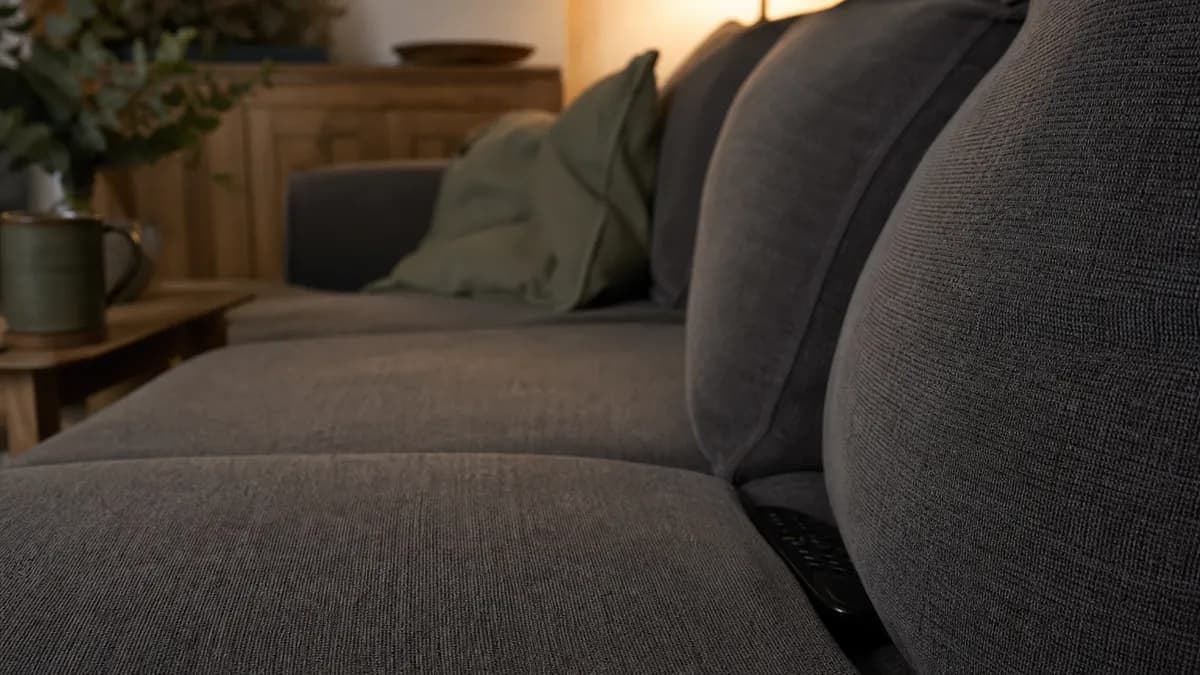
Every household has one. Four adults, one sofa, and a remote finder would pay for itself by Thursday. The TV remote is the most-lost object in the average British home precisely because it never leaves it, nothing focuses the mind like the fear of losing something outdoors, and a remote enjoys no such fear. It slides between cushions, migrates to the kitchen, and once, memorably, ends up in the fridge next to the milk.
This is a practical look at solving that, and at the other five things in your house that go missing on the same schedule.
Why a remote finder is the one most households need
It is worth understanding the failure mode, because it explains what the fix has to do.
A remote is dark, flat, roughly cushion-coloured and completely silent. It has no designated home, because it lives wherever the last person put it down. And crucially, it is only ever missed at the exact moment someone wants to use it, which is to say, when everyone is already sitting down and nobody wants to get up.
Every one of those properties is a design problem you can attack. You cannot make the remote memorable. You can make it noisy.
What is genuinely worth tagging indoors
Not everything needs a tracker. These six are the ones that repay it, in rough order of frustration caused.
The TV remote. Obvious, and the reason you are reading this.
Game controllers. Same problem, higher stakes, and they cost a great deal more to replace than a remote does.
The car keys that live in a bowl. Or the fruit bowl, or the drawer, or the coat you wore on Tuesday. Household keys go missing indoors far more often than they are lost outdoors.
The good scissors. Or the tape measure, or the torch, the shared tool that everyone borrows and nobody returns. Tag it and the arguments stop being about blame and start being about geography.
A child's soft toy. Not funny at bedtime. A small tag inside a seam turns a household crisis into a two-minute search.
The spare set of anything. Spare keys, spare glasses, the second charger. Nobody notices these are missing until the moment they are urgently needed.
What is not worth tagging
Phones, because your phone can already be found. Laptops, for the same reason. Anything you have never actually lost, a tracker on an object that stays put is a solution looking for a problem, and clutters your Items list.
Attaching a tag to something that has no keyring
This is the practical hurdle indoors, since remotes and controllers have nowhere obvious to hang a tag.
- Under the battery flap. Some remotes have room in the battery bay, or a hollow behind it. Best-looking solution, when it fits.
- On the back, with a strip of adhesive. Use proper double-sided mounting tape, not sticky tape. It survives being sat on; sticky tape does not last a fortnight.
- In a silicone sleeve. Slide-on sleeves for remotes will hold a coin tag against the back or the underside, and they come off cleanly.
- In the sofa arm caddy. If the remote lives in a fabric caddy that itself goes missing, tag the caddy.
One warning: do not tape a tag over the infrared window at the front of the remote, or you will spend a fortnight convinced the batteries are dying.
A note on batteries and hiding places
Anywhere you hide a tag, you will one day have to reach it again to change the cell. Behind a battery flap is fine. Sewn permanently inside a cushion is not, and neither is glued inside a sealed remote. Give every tag a route back out before you commit to a hiding place, or you will end up buying a replacement rather than a sixty-pence battery.
The habit that halves the problem
A tracker is a rescue tool. The prevention is duller and works better: give the remote a landing spot. A shallow tray on the coffee table, a hook, a specific end of the shelf. Households that adopt this stop losing remotes within a fortnight, because there is no ambiguity about where it goes.
Combine the two and you get the best result. The tray catches ninety per cent of cases, and the tag catches the evening when somebody watched a film in the spare room. Who in the house should be able to ring what is a separate question, and one our guide to sharing tags works through.
How Air Tracker helps
Indoors is where Air Tracker is at its most useful, because the speaker does the work rather than the map. Tap Play Sound in Find My on your iPhone and the tracker rings at 80–100 dB, enough to carry through a sofa cushion, a folded throw or a closed drawer, from anywhere within roughly 60 metres. In a normal house, that is every room at once.
At 36.3 mm across, 9 mm deep and roughly ten grams, it is small enough to sit under a remote on a strip of mounting tape without making it wobble on the table. The battery is a CR2032 that lasts up to two years and takes seconds to swap, so a tag hidden inside a soft toy does not need unpicking every few months. It is IP67 rated, which matters more indoors than you would think, given how many remotes meet a mug of tea.
If you share the house, iOS 17 and later lets you share an item with family members, so anyone can ring the remote from their own phone instead of shouting for yours. It pairs with iPhones and iPads from iOS 14.5 onwards, and Android handsets are not supported.
Two trackers come in every box with free UK delivery, for under £15. one for the remote, one for the keys.
Written by Item Finder Updated
More from the journal
 Lost and found5 min read
Glasses finder: realistic options for specs and hearing aids
A glasses finder small enough to sit on your frames does not really exist. Here is what a coin-sized tag can honestly do for specs, cases and hearing aids.
 Lost and found5 min read
Lost wallet UK: what to cancel, and in what order
Lost wallet in the UK? Freeze the cards in the banking app first, then the driving licence and any travel documents. Here is the full order and the deadlines.
 Lost and found5 min read
An item finder for family life: sharing tags in Find My
An item finder for family only earns its place when everyone can ring it. How sharing works on iOS 17, who to add, and what each person should tag.