How to stop losing things: habits that actually work
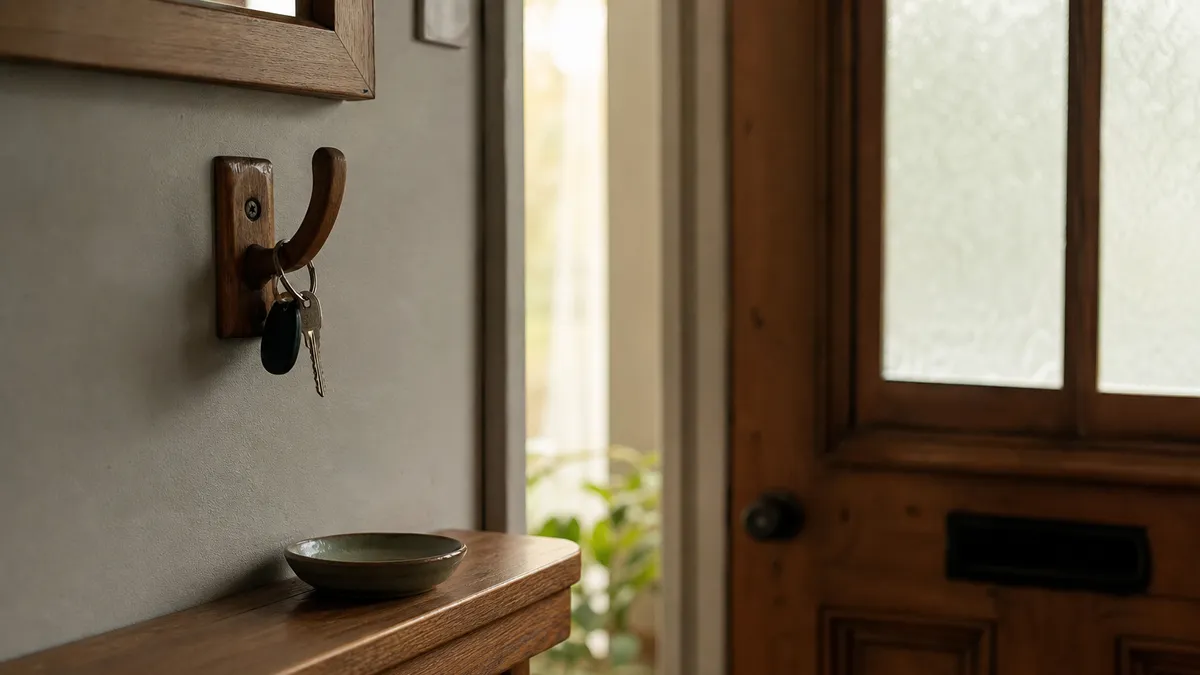
Learning how to stop losing things is less about discipline than about design. Most people who lose things are not careless; they are running a routine with too many valid outcomes, and the object ends up in whichever of them is nearest. The fix is to reduce the number of correct answers to one. This is an honest look at which habits survive contact with a bad morning, which do not, and where the trade-off between a system and a gadget actually falls.
Why the usual advice fails
"Be more organised" fails because it asks for effort at the exact moment you have none. Objects are put down during transitions, arriving, leaving, being interrupted, and a transition is precisely when attention is committed elsewhere. Any system that requires you to think will be skipped on the days you most need it.
There is a second failure mode, subtler and more common. Many systems have more than one correct answer. Keys live on the hook, or in the bowl, or in the coat pocket, or in the bag, and all four feel right. The moment a system has multiple acceptable destinations it stops being a system and becomes a set of places to search. That is not disorganisation; it is an ambiguity problem.
So the test for any habit worth adopting is narrow: does it remove a decision, and does it survive being rushed? Very few do.
The three that survive
One home, chosen for convenience rather than tidiness. Pick the single place each critical object lives, and pick it where your hand already goes, inside the door, not in a drawer in another room. A hook by the door works not because it is neat but because it is on the path you already walk. A bowl on a hall table that is three steps out of your way will be abandoned inside a fortnight, however handsome it is.
Attach the small thing to the large thing. Objects are lost in inverse proportion to their size. A key on a ring with a fob is harder to lose than a key alone; a wallet inside a bag is harder to lose than a wallet in a pocket; a hearing aid in a case is a different object from a hearing aid. This habit costs nothing and does the most work of the three, because it converts a hard-to-track item into an easy-to-track one.
The doorway pat. A two-second physical check at the threshold, always the same order, keys, phone, wallet. The value is not the checking; it is that the doorway is a fixed trigger, so the habit fires without a decision. People who do this reliably are not more conscientious than people who do not. They have simply attached the behaviour to a place rather than to an intention.
The ones that do not survive
Worth naming, because they all sound sensible.
Elaborate labelled storage. Excellent for things you use monthly, useless for things you use hourly. Daily objects need speed, and a labelled box in a cupboard is slower than a worktop.
"I'll just remember where I put it." Memory encodes intention, not placement. You will remember arriving home; you will not remember the surface your hand chose while you were thinking about the shopping.
Putting it "somewhere safe". The phrase is a reliable predictor of loss. A safe place is by definition an unusual one, which is the same as an unmemorable one.
One big tidy-up. Tidying changes where things are without changing where they go. The week after a declutter is a statistically dangerous week for keys.
The honest trade-off with buying a tracker
Here is where an article on a shop's blog has to be careful, so let us be explicit about the limits.
A habit is free, applies to everything you own, and prevents the loss rather than resolving it. A tracker costs money, applies only to the specific object it is attached to, and does nothing until after the loss has happened. On those terms the habit is plainly the better instrument, and anyone who tells you otherwise is selling something.
But habits have a failure rate, and it is not zero. They fail when the routine changes, a holiday, a new job, a house move, illness, a child. They fail when you are carrying something in both hands. And they fail silently, which is the problem: you do not find out the habit lapsed until you are standing in the hall at 8.15.
A tracker is the cover for that failure rate on a small number of items. It is not a substitute for the system, and it is a poor primary strategy: the objects you never tag are unaffected, and a tag on the wrong thing is money spent on nothing. The sensible reading is that the habit handles the ninety-five per cent and the tag handles the five per cent that matters most.
There is also a subtler benefit that is easy to overstate and worth stating carefully: a tag with a left-behind alert does prevent losses rather than only resolving them, because the warning arrives while the object is still recoverable. That is the one respect in which the gadget does the habit's job, and it is the feature to switch on if you switch on nothing else.
A considered recommendation
If you are choosing where to spend your attention, spend it in this order.
- Fix the ambiguity first. One home per critical object, chosen on the path you already walk. This is free and it is the largest single improvement available.
- Attach small things to large things. Also free, and it quietly removes entire categories of loss.
- Add a trigger, not a rule. The doorway pat, in a fixed order.
- Then, and only then, tag the two or three items whose loss would ruin a day. Not everything. Deciding which ones is most of the value, and we worked through that separately in how many trackers a house needs.
If you do the first three and never buy anything, you will lose markedly fewer things than you do now. That is a fair outcome for an article to recommend.
How Air Tracker helps
Air Tracker is the fourth item on that list rather than the first, and it is worth being clear about which part of the problem it addresses.
It sits on a keyring or inside a bag and connects to the Find My app already on an iPhone. When a habit has failed and the object is somewhere in the building, Play Sound makes it chime at 80–100 dB, audible through a coat, a cushion or a shut door, anywhere inside roughly 60 metres. When it is further away, Apple devices passing within range put a last seen position on the map, which converts an open-ended search into one phone call. Notify When Left Behind is the feature that does preventative work, warning you as you move away from the item rather than when you next need it.
The limits are real and worth repeating. It is an Apple-only accessory: iOS 14.5 upwards on an iPhone or iPad, and no Android compatibility whatsoever. There is no Ultra Wideband arrow, so you follow a sound rather than a direction. And it helps with exactly the objects you attach it to and no others, which is why the habits above are not optional.
A box of two tags, with a key ring for each, costs less than £15 and is posted free. use them on the two things that would ruin a morning.
Written by Item Finder Updated
More from the journal
 Guide4 min read
The real time spent looking for lost items each day
UK research puts the time spent looking for lost items at eight and a half minutes a day. Here is what that adds up to, and how to get most of it back.
 Guide5 min read
What is an item finder and how does it work?
An item finder is a coin-sized Bluetooth tag for your keys and bags. Here is what one does, how it finds things, and the jobs it cannot do.
 Guide5 min read
Best key finder UK: what to look for before you buy
Choosing the best key finder UK shoppers can actually rely on comes down to six things, network, volume, battery, water rating, fit and cost per tag.