What is an item finder and how does it work?
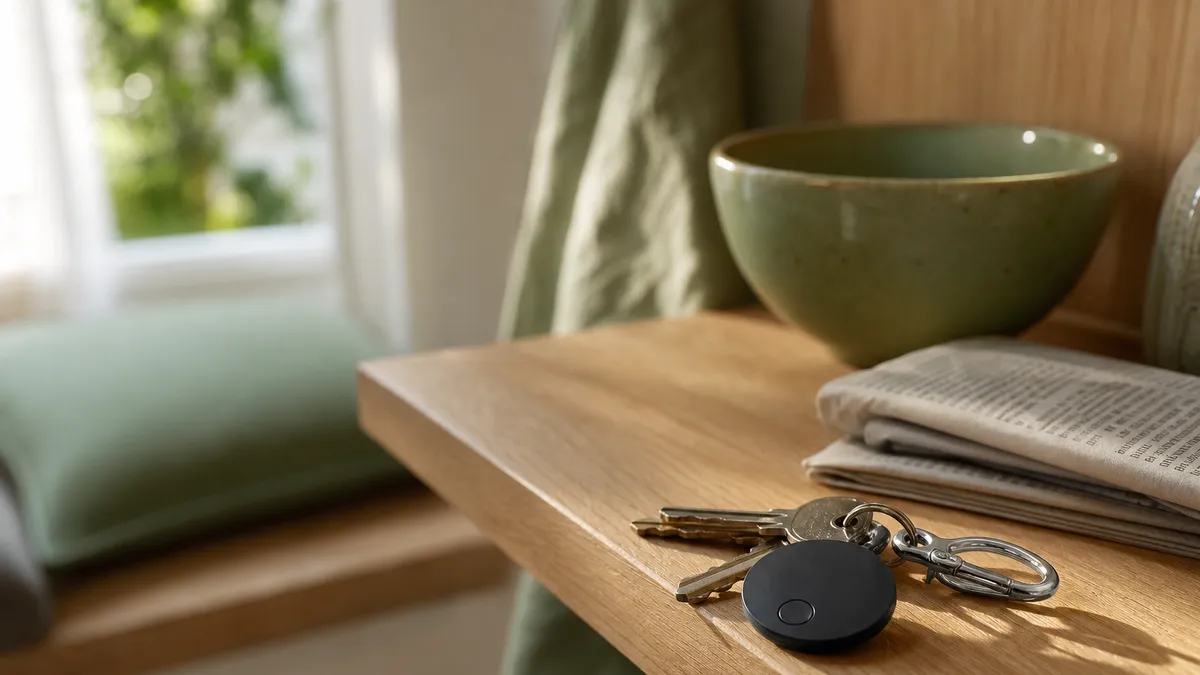
Lose your keys twice in one week and somebody will tell you to buy an item finder. It is decent advice. The trouble is that the phrase covers everything from a whistle-activated keyring to a subscription GPS box, and the gap between those two things is enormous. This piece explains what the modern version really is, how it manages to point at a bag on the other side of a city, and the handful of jobs it will never do.
Three components in a plastic coin
Open one up and there is almost nothing inside. A Bluetooth Low Energy radio. A tiny piezo speaker. A coin cell battery. That is the entire machine.
The radio does not transmit your location, because it has no idea where it is. There is no GPS receiver, no SIM card and no aerial pointed at a satellite. What the radio does, roughly every couple of seconds, is shout a short anonymous identifier into the air, the digital equivalent of a lighthouse flash. It has done this since the moment you paired it and it will keep doing it, silently, until the battery gives out.
Everything clever happens elsewhere. The tag is dumb on purpose: that is why it runs for years on a battery the size of a shirt button.
How does an item finder work when the thing is nearby?
"Nearby" means within Bluetooth reach, realistically up to about 60 metres in the open, considerably less through a stud wall, a leather bag or the back of a sofa.
In that situation your phone can hear the tag directly. You open the tracking app, choose the item and ask it to make a noise. The tag's speaker chirps, you follow the sound, you find the thing. It is unglamorous and it is the feature you will use ninety per cent of the time, because ninety per cent of losses happen inside your own home.
Two details decide whether this works in practice:
- Loudness. A quiet tag is a useless tag. Somewhere in the 80 to 100 decibel range is enough to carry through a cushion, a coat pocket or a closed drawer.
- Where the tag sits. A tag buried under a pile of coats behind a closed door is muffled. Attach it to the outside of a bag rather than the bottom of it.
You will also see a "last seen" location on a map, updated whenever your own phone was last in range. Nine times out of ten that pin is enough on its own: it tells you the keys are in the house, not at the pub, which changes how you search.
How does an item finder work when the thing is miles away?
This is the part people find hard to believe, so it is worth spelling out.
Your tag is still just flashing its anonymous identifier. But so is every other Bluetooth device around, and the phones walking past are listening. When a stranger's iPhone picks up your tag's signal, it quietly notes the tag's identifier alongside its own GPS position, encrypts that pairing, and forwards it on. Nobody is told anything. The passer-by has no notification, no app to open and no idea it happened.
You then open your own app and it decrypts the reports that belong to you. A pin appears where somebody else's phone last overheard your tag.
Three consequences follow from that design, and they are the reason this approach beat the old standalone tracker apps:
- Coverage tracks footfall. In a city centre, a railway station or an airport, updates arrive constantly. On an empty moor at midnight, nothing arrives at all until somebody walks past.
- Only you can read the result. The location reports are encrypted end to end. The company that made the tag cannot see them, and neither can the stranger whose phone relayed them.
- It costs nothing to run. There is no data plan, because the tag never uses data. The passing phones do all the work.
The identifier the tag broadcasts also rotates on a schedule, so it cannot be used to follow you around a shopping centre by anyone with a scanner.
The three things an item finder cannot do
Honesty is more useful than hype here, so:
It is not a live tracker. You get the last confirmed sighting, not a moving dot. If the item is genuinely on the move, the map lags behind reality.
It cannot search on demand. You cannot force an update. If no phone has been near your bag since Tuesday, Tuesday is what you will see, no matter how many times you refresh.
It will not survive being separated from the thing. A tag in the outside pocket of a stolen rucksack gets thrown in a bin within the hour. Tags are excellent against forgetfulness and mediocre against determined theft.
If you want live, continuous, anywhere-in-the-country tracking, you want a GPS unit with a mobile subscription, a much bigger battery, and a monthly bill to match. Different tool, different problem.
How Air Tracker helps
Air Tracker is exactly the machine described above, built to work with the Find My app already installed on your iPhone. It rings at 80–100 dB, which is the difference between hearing your keys through a sofa cushion and not hearing them at all, and it reaches roughly 60 metres before it hands over to the network of passing Apple devices.
The practical details are the ones that matter day to day. The battery is a standard CR2032 that lasts up to two years and that you can replace yourself in about fifteen seconds with a coin, so the tag does not become landfill the first time it goes flat. It is IP67 rated, so a downpour or a dropped-in-a-puddle keyring is a non-event. It measures 36.3 mm square and 9 mm thick and weighs around ten grams, which is small enough that you stop noticing it on a keyring after a day. The chip is MFi certified, so location reports are encrypted end to end, and Apple's unwanted-tracking alerts work as designed.
Two things it deliberately does not do: it has no Ultra Wideband, so there is no arrow pointing you across a room, and the phone in your pocket has to be an Apple one, on iOS 14.5 or newer, because Android is not supported. If you are shopping rather than simply reading, our list of what to compare before buying goes further.
Every box holds two trackers, comes with key rings and ships free in the UK for under £15 a box. see what is included.
Written by Item Finder Updated
More from the journal
 Guide4 min read
The real time spent looking for lost items each day
UK research puts the time spent looking for lost items at eight and a half minutes a day. Here is what that adds up to, and how to get most of it back.
 Guide5 min read
Best key finder UK: what to look for before you buy
Choosing the best key finder UK shoppers can actually rely on comes down to six things, network, volume, battery, water rating, fit and cost per tag.
 Guide5 min read
Wallet tracker: what actually fits and what does not
A coin-shaped wallet tracker will not slide into a card slot. Here is where one genuinely fits, what card tags give up, and what to do with slim wallets.