Best key finder UK: what to look for before you buy
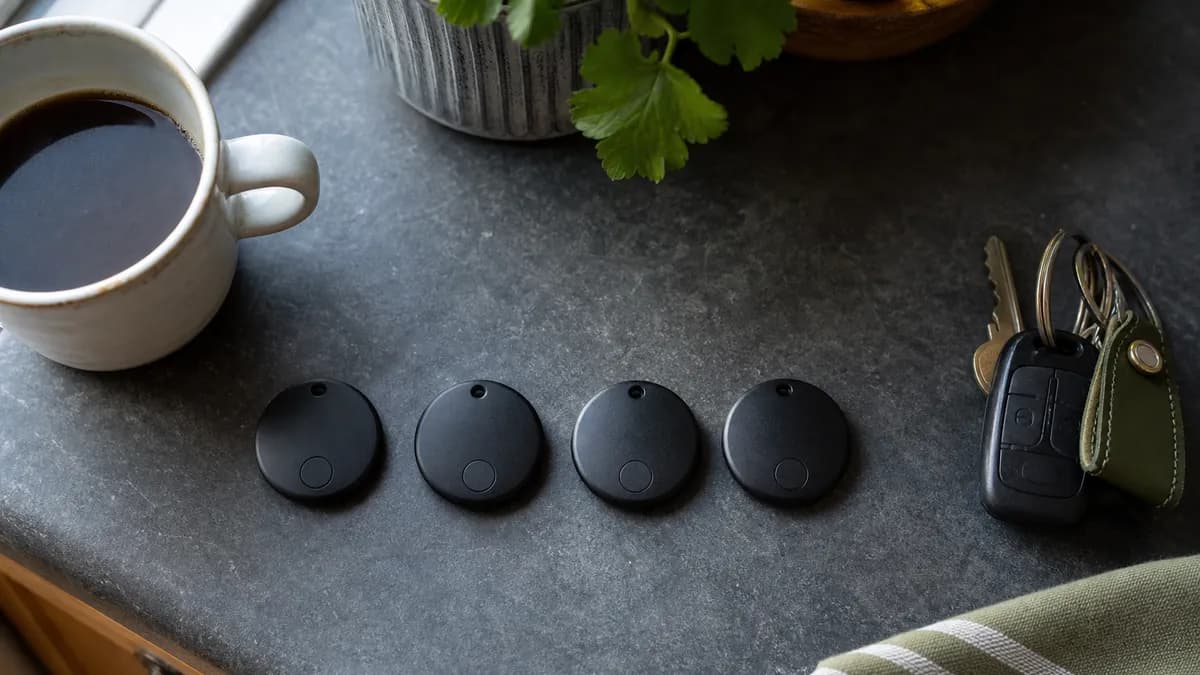
Search for the best key finder UK sellers offer and you will get forty products, thirty of which are the same white-label disc with a different sticker on the back. The specification sheets all look identical. They are not. Six things separate a tag that finds your keys from a tag that lives in a drawer, and only two of them appear in the headline bullet points.
Work through them in this order.
1. Which network does it borrow?
This is the single decision that matters, and everything else is detail.
A key finder has no GPS of its own. When your keys are out of Bluetooth range, the only way you learn anything is if somebody else's phone happens to overhear the tag and pass the sighting on. So the question is not "how good is the tag" but "how many phones are listening".
- Apple's Find My network uses the iPhones, iPads and Macs of the general public. In a British high street or a railway concourse that is a lot of listeners. The catch: your handset has to be Apple-made, running iOS 14.5 at minimum, and Android owners get nothing out of it.
- A manufacturer's own app network only sees phones belonging to people who installed that company's app. In the UK that is a much thinner crowd, and it collapses outside city centres.
If you own an iPhone, a Find My compatible tag is the obvious buy. If your household is on Android, be honest with yourself and shop for something built for Google's Find Hub instead, a Find My tag will not pair with your phone at all.
2. How loud is it, really?
Most key losses happen indoors, at home, within twenty feet of you. The map does not solve those; the speaker does.
Manufacturers quote decibels at a distance they rarely specify, so treat the number as a rough band rather than gospel. Below about 75 dB you will not hear the tag through a sofa cushion or a zipped coat pocket. In the 80–100 dB band you will, from another room, with the telly on. That is the band worth paying for.
A related and underrated point: how long does it ring for? A tag that chirps twice and stops is far less useful than one that keeps going while you move around the house.
3. What happens when the battery dies?
There are two designs on the market and one of them is a trap.
| Sealed battery | Replaceable CR2032 | |
|---|---|---|
| Life before it dies | often quoted at a year | up to two years |
| What you do next | buy a new tag | buy a 60p coin cell |
| Waste | the whole device | a battery |
| Cost over five years | three tags | one tag, two cells |
A CR2032 is sold in every supermarket, corner shop and pharmacy in the country, usually in a multipack. Swapping one takes about fifteen seconds and a twenty-pence piece. Sealed tags are cheaper on day one and considerably more expensive by year three.
4. Will it survive British weather?
Keys go outside. They get dropped in car parks, sat on wet garden walls and carried through horizontal rain in February.
Look for an IP rating rather than the word "waterproof", which means nothing on its own. IP67 is the sensible target: dust-tight, and fine with immersion in shallow water for half an hour. That covers rain, a spilled pint, a puddle and a brief spell in a washing machine drum you forgot to empty. It does not cover a swimming pool for an afternoon, and no tag at this size does.
5. Does it actually attach to keys?
More tags fail this test than you would believe. Some have no hole at all and expect you to buy an adhesive pad or a silicone sleeve, which adds bulk, adds cost and eventually falls off.
Check three things before you buy:
- A moulded hole in the body, not a stick-on loop.
- A key ring in the box. If it is not listed in the contents, assume it is not there.
- Thickness. Anything much over 9 mm turns a slim keyring into a paperweight and starts scratching the inside of a coat pocket.
6. Cost per tag, not cost per box
Almost nobody needs one tracker. Keys and a bag is two. Keys, bag, suitcase and the spare set in the drawer is four. So compare on cost per tag and ignore the box price entirely.
This is where multi-packs earn their keep. A single premium tag from a phone manufacturer can cost more than a whole multi-pack of Find My compatible tags with identical network access, because you are paying for Ultra Wideband precision finding, which is genuinely lovely and genuinely optional. We break down that trade-off in key finder versus AirTag.
Putting the key finder UK checklist together
Run a shortlist through the six points in order and most of it eliminates itself. Anything that will not join a network your phone can read is out immediately, whatever else it offers. Anything with a sealed battery is out unless it is unusually cheap and you have accepted it is disposable. Anything under about 75 dB is out, because you will not hear it when it matters. What is left gets judged on fit and cost per tag.
That is a five-minute job, and it is why the same handful of products keep coming out on top of any honest key finder UK shortlist: the winners are not the ones with the longest feature list, they are the ones that got the first three questions right.
How Air Tracker helps
Air Tracker was designed against exactly this checklist, which is why the specification reads the way it does.
It joins Apple's Find My network directly, so it appears in the Items tab of the app already on your iPhone with no extra account, no second app and no subscription. It rings at 80–100 dB and stays audible through cushions and coat linings. The battery is a replaceable CR2032 rated for up to two years. It is IP67, so a wet British car park is not an event. It measures 36.3 mm across and 9 mm thick, weighs about ten grams, and has a proper moulded hole, with the key rings supplied in the box rather than sold separately.
Two honest caveats. There is no Ultra Wideband, so you get a map pin and a loud noise rather than an on-screen arrow. And Android is out, the phone has to be Apple-made, on iOS 14.5 upwards.
Boxes contain two trackers, delivery within the UK is free, and there is a 30-day return window if it does not suit you. check the current price.
Written by Item Finder Updated
More from the journal
 Guide4 min read
The real time spent looking for lost items each day
UK research puts the time spent looking for lost items at eight and a half minutes a day. Here is what that adds up to, and how to get most of it back.
 Guide5 min read
What is an item finder and how does it work?
An item finder is a coin-sized Bluetooth tag for your keys and bags. Here is what one does, how it finds things, and the jobs it cannot do.
 Guide5 min read
Wallet tracker: what actually fits and what does not
A coin-shaped wallet tracker will not slide into a card slot. Here is where one genuinely fits, what card tags give up, and what to do with slim wallets.