Where to keep your keys at home: a UK guide
Where to keep keys at home is two questions wearing one coat. The tidiness question is how to stop hunting for them every morning. The security question is how to stop somebody else getting hold of them through your front door. The answers pull in opposite directions, because the spot that is most convenient is usually the spot a thief would pick. This is how to satisfy both.
Where should you keep your keys at home?
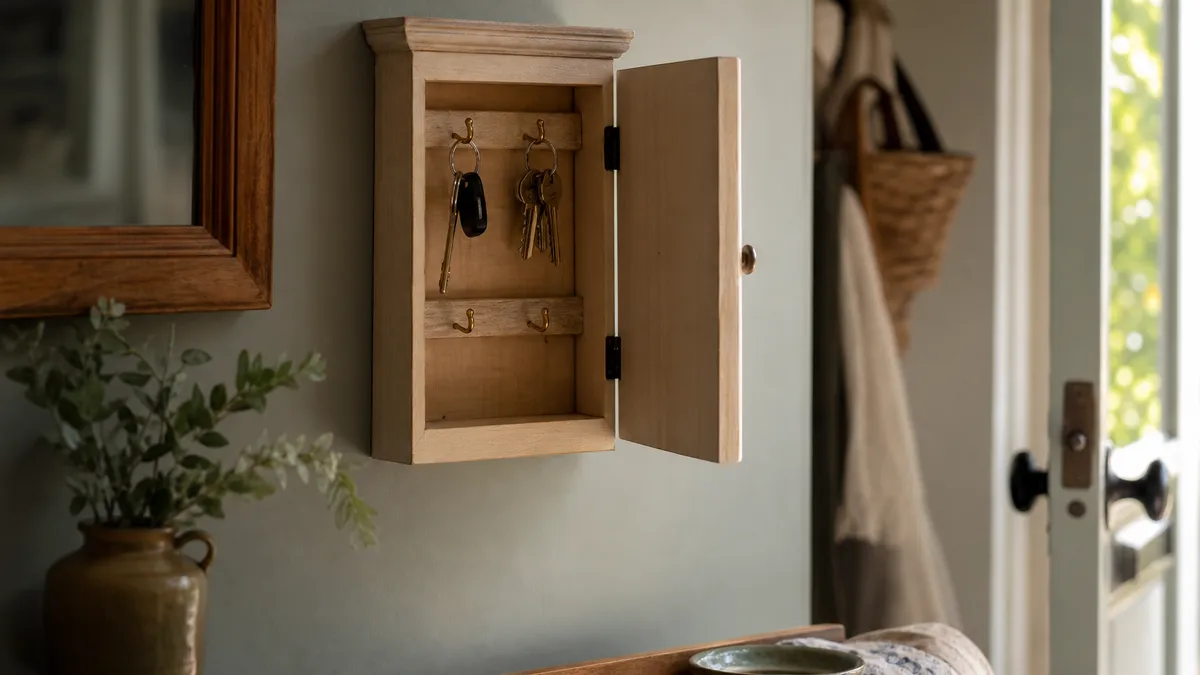
In a fixed place, roughly two to three metres inside the house, out of sight of every window, the letterbox and any glass panel in the door. A hook or a shallow bowl works as well as anything expensive, and a small wall cupboard works better still because it hides what is inside. The rule to hold on to is that keys should be the first thing you reach on the way out and the last thing anybody could see or reach on the way in.
That distance is the whole trick. Close enough that you walk past it every time, far enough that no arm, hook or rod reaching through the door can get there.
Is it safe to keep keys by the front door?
No, and it is the single most common mistake in British homes. A hall table within reach of the letterbox is exposed to letterbox fishing, where a hooked rod, a length of wire or a bent coat hanger is fed through the flap to lift keys from the nearest surface. Police forces across England and Wales warn about it regularly, and the whole thing takes well under a minute with no noise and no broken glass.
The same applies to a hook mounted beside the door and to any key left in the back of a lock overnight. If you can see the keys from outside through the glass, so can somebody standing on your step at two in the morning.
Three cheap fixes, in the order most households should do them:
- Move the keys further inside. You should now be unable to see them when standing in the open doorway.
- Fit a letterbox cowl, guard or internal restrictor. The flap still opens for post, but nothing can be manoeuvred through and angled downwards.
- Stop leaving keys in the lock. A thumbturn lock gives you the same convenience without a key on display.
Where should car keys go, and does a signal blocking pouch work?
Car keys go furthest from the front of the house, and yes, a signal blocking pouch works, as long as you actually use it every night. Modern keyless fobs broadcast constantly, and a relay attack involves two people: one holding a device near your wall or door to pick up that signal, another standing at the car repeating it. The car believes the key is present and unlocks.
Police crime prevention guidance is consistent on all of this. Keep fobs away from doors and windows, use a signal blocking pouch or a metal tin, and add a visible deterrent such as a steering wheel lock, which is worth more than it looks because thieves prefer the quiet option.
Worth knowing: burglary and car theft have merged into one crime in many parts of the country. Homes are now broken into specifically to find the keys sitting inside, which is exactly why the hallway is the wrong room for them.
Where should you keep a spare key?
With a person, not under a thing. A neighbour, a relative nearby, or a colleague is safer than every hiding place outside your house, because thieves know all of the hiding places. Under the mat, in a plant pot, on the ledge above the door and inside a fake stone are checked first, and take seconds each.
If nobody local can hold one, a key safe fixed to the wall is the next best option, but choose a police approved model and site it somewhere not visible from the pavement. Some insurers take a dim view of a key safe in a claim, so check the policy wording before you fit one.
Two rules for whatever you choose. Never label a key with your address or even your house number. And if a set goes missing entirely rather than turning up, treat the locks as compromised, which is a decision with costs we went through in what a locksmith charges versus a key finder.
How do you set up a key spot the whole household will use?
By choosing it for where people already walk rather than where it looks neat. A system that needs anybody to change their route lasts about four days. Work through it in this order.
- Stand in the doorway and walk your normal path into the house. Notice where your hands naturally empty: a worktop, the end of the bannister, the arm of the sofa.
- Pick the first of those points that is out of sight of the door and the windows. That is your spot, whether or not it is where you would have chosen.
- Put something physical there that holds keys and nothing else. A bowl that collects post as well stops being a key spot within a week.
- Tell everyone, once, and then use it yourself without comment for a fortnight. Households copy behaviour far more reliably than they follow instructions.
- After two weeks, check whether keys are turning up anywhere else. If they are, the spot is in the wrong place, not the people.
What about a flat or a shared entrance?
The same logic applies, with one addition: in a block, the communal door is not your front door, so treat your own flat entrance as the boundary that matters. Fobs for a shared entrance should never carry a flat number, and a lost communal fob should be reported to the managing agent immediately, because a deactivation costs a phone call and a replacement lock costs a great deal more.
Renting adds a second consideration, which is who pays when keys go missing and locks have to change. That is set out in lost keys in a rented flat.
How Air Tracker helps
A fixed key spot solves the security half of this. Air Tracker is for the mornings when the spot was not used.
It clips to a keyring with the key ring supplied in the box and pairs with the Find My app already on an iPhone, so there is nothing extra to install and nothing to subscribe to. It needs an iPhone or iPad on iOS 14.5 or later, and Android phones cannot use it.
A tap on Play Sound sets it ringing between 80 and 100 decibels across roughly sixty metres, which is loud enough to escape a coat pocket, a rucksack or the gap beside a sofa cushion. Outside that range, Apple devices going past refresh the last known place on the map, with the location encrypted end to end. Share the item with a partner or a teenager on iOS 17 or later and they can ring it without borrowing your phone, which is the feature that ends the morning argument.
What it will not do is protect keys that somebody else has taken, and it is not a substitute for moving them away from the door. It is a coin sized tag, IP67 rated, running up to two years on a CR2032 you can change yourself, sold two to a box under fifteen pounds with free UK delivery. see the two pack.
Written by Item Finder Updated
More from the journal
 Guide4 min read
The real time spent looking for lost items each day
UK research puts the time spent looking for lost items at eight and a half minutes a day. Here is what that adds up to, and how to get most of it back.
 Guide5 min read
What is an item finder and how does it work?
An item finder is a coin-sized Bluetooth tag for your keys and bags. Here is what one does, how it finds things, and the jobs it cannot do.
 Guide5 min read
Best key finder UK: what to look for before you buy
Choosing the best key finder UK shoppers can actually rely on comes down to six things, network, volume, battery, water rating, fit and cost per tag.