School lost property: what the 2026 survey found
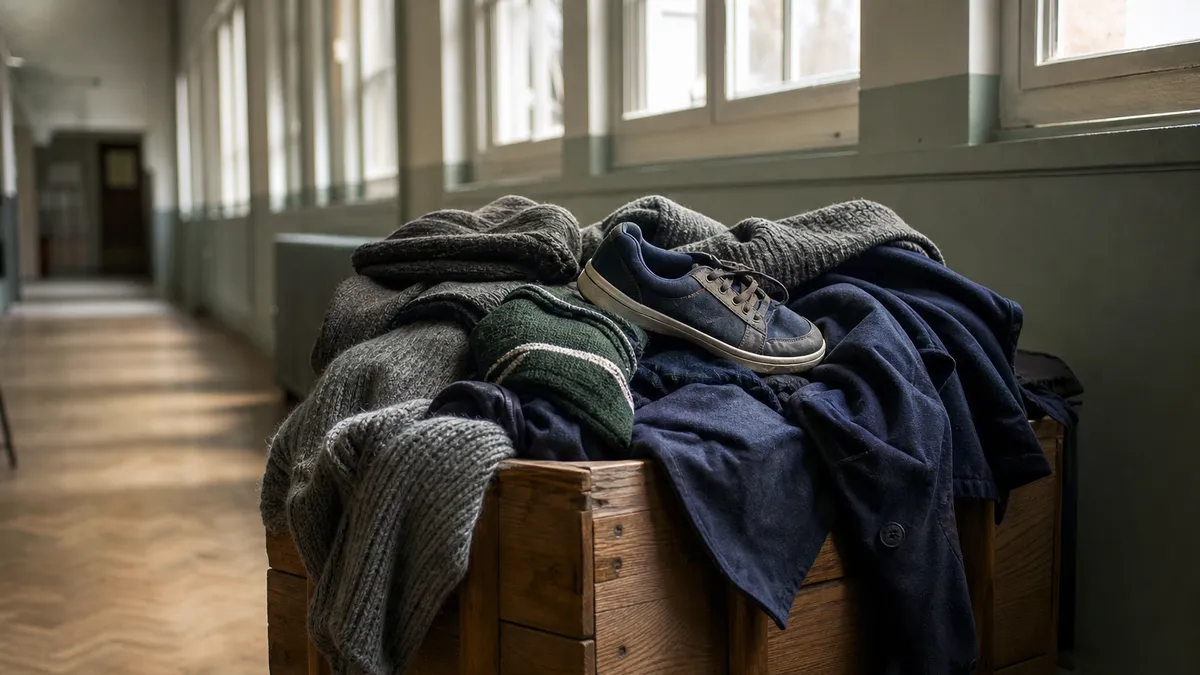
Every parent knows the crate by the hall door, and now there is data on it. A survey of UK primary schools carried out in February 2026, published by name-label maker Label Planet in May, puts hard figures behind the school lost property problem, and the findings are blunter than the usual hand-wringing. Two thirds of schools call it a real problem, nine in ten say it is mostly jumpers, and almost every school agrees on the fix that almost nobody does.
What the survey actually measured
Schools were asked to rate the severity of their lost property on a scale, to say what ends up unclaimed, and to name what would help. The distribution is the part worth sitting with: 49% put their problem in the medium band, 18% in the severe band and 33% in the mild band. That is two thirds of primary schools describing lost property as a running operational headache rather than an occasional nuisance.
The unclaimed pile is astonishingly consistent. Ninety per cent of schools put jumpers, cardigans, sweatshirts and hoodies in their top three. Coats and outerwear followed at 41%, winter accessories such as hats, gloves and scarves at 27%, and PE kit at 19%. Among non-clothing items the water bottle is king at 24%, with lunchboxes on 11% and shoes and socks on 7%.
The survey also pinned down who loses what. Children in Years 1 to 3 were named as the worst offenders, which will surprise nobody who has watched a six-year-old take a jumper off in the playground and walk away from it without breaking stride.
The fix everyone names and nobody does
Here is the number that makes the rest of it click. Eighty-eight per cent of schools said name labels would fix their lost property problem, and only 3% reported that most of the kit coming through their doors is actually labelled. More than two thirds said fewer than a quarter of items in the crate carry a name.
One school's comment, quoted in the May release, is the whole story in a sentence:
All labelled items make their way back to the children. It's only the unlabelled that goes unclaimed.
A follow-up write-up in July 2026 reported that 79% of teachers describe the end-of-term volume as staggering, and that more than half think the problem is worse than it used to be.
My view, for what it is worth: the labelling gap is not laziness. It is that labelling is a job you do once a year for kit that changes three times a year, and the feedback loop is invisible. Nobody sees the jumper come home because it was labelled. They only ever see the jumper that did not.
What schools are actually doing about it
The same survey asked what helps. The answers were unglamorous and mostly organisational:
- Make the pile accessible. 36% of schools said the biggest win was simply letting parents look through it, rather than keeping it behind a locked office door until a fixed date.
- Promote labelling actively. 14% ran campaigns rather than a line in September's welcome letter.
- Remind, repeatedly. 12% send regular nudges rather than one annual plea.
- Push accountability back to families. 42% said they want more parental involvement, which is a polite way of saying the crate is not a school's job to solve alone.
None of that touches technology, and rightly so. You are not going to tag forty jumpers.
Where the household version of this problem starts
The school crate is the visible end of something that carries on at home. The kit that gets lost at school is low-value and high-volume: jumpers, bottles, gloves. The things that go missing at home skew the other way, fewer items, but each one expensive or inconvenient enough to derail a morning. House keys. A wallet. The car fob. A hearing aid.
Those are the items worth spending on, and the split matters when you are deciding what deserves attention. Labels handle the cheap and numerous. Something that makes a noise handles the few things you genuinely cannot leave the house without. For the household end of that, our guide to habits that stop things going missing in the first place covers the free half of the answer.
How Air Tracker helps
Air Tracker is not a solution to a crate of jumpers, and it would be silly to pretend otherwise. What it does address is the other list, the handful of things whose disappearance stops the school run dead.
Clip one to the keyring that opens the front door and your iPhone will ring it at 80–100 dB from anywhere inside roughly 60 metres, which in practice means the whole house, the car on the drive and most of the garden. Drop the second one into the bag that carries the swimming kit, the packed lunch or the work laptop, and switch on the left-behind alert: your phone warns you as you walk away from it, with the last place it saw the bag already pinned on the map. If it has genuinely gone elsewhere, the Find My network of passing Apple devices keeps that pin refreshed without any subscription or second app.
The honest limits are worth stating in the same breath. Apple devices only, from iOS 14.5 onwards; an Android handset will not pair with it under any circumstances. There is no Ultra Wideband arrow to walk you in, you get a sound and a map. And because a family shares items through Find My on iOS 17 and later, a partner can ring the same tag, which is usually more useful than a second set of keys.
The tags are IP67 rated for a wet playground, take a coin cell you change yourself, and arrive two to a box at under £15. take a look at the pair.
Sources
- PR Newswire / Label Planet, "The Hidden Price Of Lost Property In UK Schools", 28 May 2026
- Stikins, "Lost Property In Primary Schools. Detailed Results Of 2026 Survey", February 2026
- Family Friendly Working, "The Lost Property Crisis: 4 in 5 teachers say the volume of lost property is staggering", 20 July 2026
Written by Item Finder Updated
More from the journal
 In the news5 min read
The cost of losing things, and the cover you have
The true cost of losing things is rarely the price tag. A September 2026 warning about double insurance is a good reason to check what you already pay for.
 In the news5 min read
Lost or stolen wallet? What the Met's new figures say
A lost or stolen wallet sends you down two different routes in the UK. New Met Police figures from September 2026 show why the label matters so much.
 In the news4 min read
Most commonly lost items: the 2026 index in full
The most commonly lost items barely change from year to year. Here is what the June 2026 Uber index and two UK data sets say about what goes missing and where.