Lost keys in the park: a dog walker's recovery plan
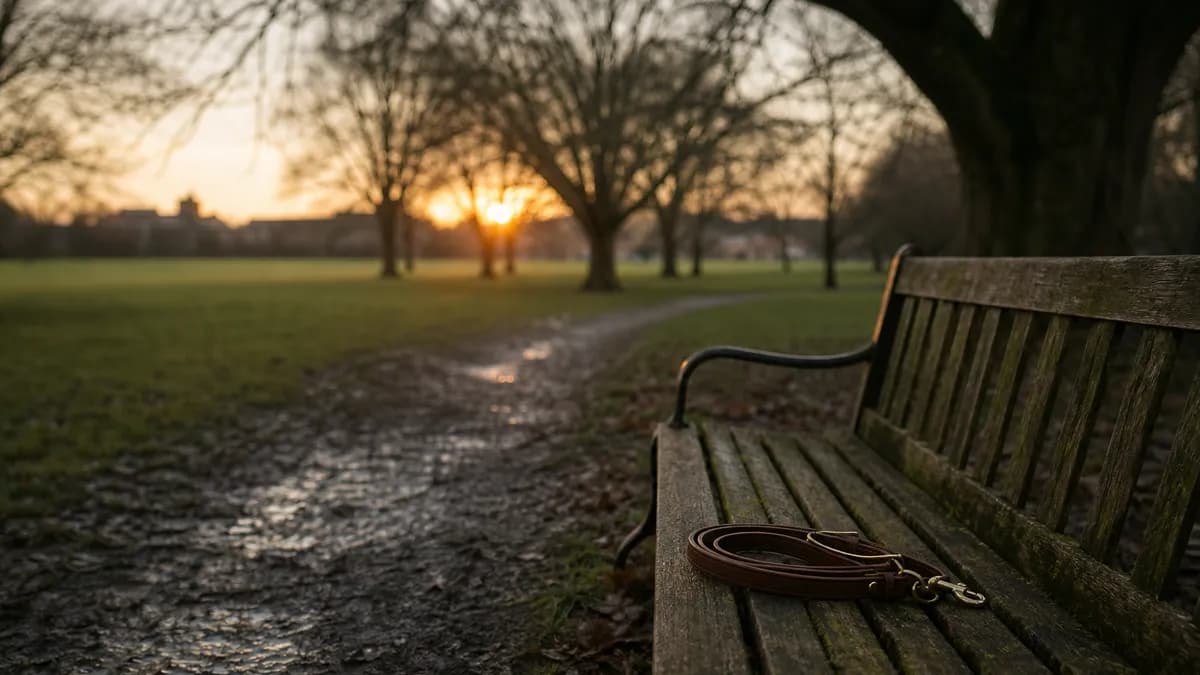
Lost keys in the park are recoverable far more often than people expect. The short answer: walk the route again in daylight, look on top of things rather than in the grass, tell the park office and the council the same day, and put a note on the gate. Most sets are found within a metre of the path by the next dog walker. Here is the full order.
What to do in the first hour
Speed matters less than method, but there is one time-critical step.
- Stop and check yourself. Coat pockets, the treat pouch, the poo-bag pocket, the dog's harness clip, the car footwell. Keys on a walk are usually not on the ground at all.
- Walk the route back, slowly, on the same side. Look at bench seats, fence rails, bin lids, gate posts and the tops of bollards, a found set is usually picked up and placed somewhere visible rather than left in the mud.
- Look where you stopped, not where you walked. Throwing a ball, taking a photo, clipping a lead on, answering the phone. Keys come out of a pocket during an action.
- Ask whoever is still there. Dog walkers keep the same routine at the same hour. The person who found them is often on the same circuit tomorrow.
- Tell the park office and the council depot. Parks staff and groundskeepers accumulate found property and are the people who empty the bins.
That last step is the one people skip, and it matters more now than it used to. Ask the Police, the service UK forces maintain jointly, says plainly that general lost and found property is no longer something officers can help with; keys and clothing sit outside the categories still accepted. There is no national desk to ring.
Where keys actually turn up outdoors
Not, usually, in the grass. Three places dominate.
- Gate posts and fence rails. The universal finder's instinct is to put keys somewhere a returning owner will see them at head height.
- The nearest bench. Second instinct, same logic.
- On top of a bin, never inside it. People are reluctant to put someone's keys in a bin, so they balance them on the lid.
Local Facebook groups and the park's own noticeboard do the rest. A laminated note on the gate with a phone number, put up the same evening, recovers a striking number of sets, you are advertising to the exact hundred people who use that path.
What it costs if they do not come back
Worth knowing before you decide how much of tomorrow to spend searching, because the number is not small. Master Locksmiths Association guidance for 2026 sets ordinary labour at about £85 an hour. The overnight emergency rate runs between £122 and £153, and simply opening a door starts near £90 before any parts are fitted.
Research published by Samsung UK in January 2026, based on a survey of 2,000 British adults, found 19% had recently mislaid their house keys, so this is an ordinary event with an expensive tail. The full 2026 replacement picture, including car fobs, is in the locksmith bill for lost keys.
The dog-walk specifics
A walk is a high-risk environment for keys for reasons worth naming, because each one has a fix.
| Risk | Why it happens | The fix |
|---|---|---|
| Shallow coat pockets | Bending to clip a lead tips them out | Zip pocket or a carabiner |
| Both hands busy | Lead, ball thrower, bags | Keys on a belt loop, not in a hand |
| Dark evenings | You cannot see what you drop | A tag that rings, not a torch |
| Muddy ground | A dropped set vanishes instantly | Bright fob or a bright tag cover |
How Air Tracker helps
Outdoors is where a tracker is at its least glamorous and most useful, because the alternative is searching a field.
Air Tracker attaches to the ring with the key ring in the box and, from your iPhone, can be made to sound at 80–100 dB anywhere within about 60 metres. On a path that is a large radius, enough to cover the stretch you think they fell on, in the dark, without a torch. Past that distance you get the map instead: the Find My app shows where the tag was last seen, and the network of passing Apple devices updates that pin when anyone with an iPhone walks near it. On a busy park route, that happens often.
The prevention feature is the better one. Turn on Notify When Left Behind and your phone tells you as you move away from the keys, at the bench, at the gate, at the car, rather than at the front door an hour later. Lost Mode adds your contact details for whoever picks them up off a fence post, and they never see where you live, because the location data is encrypted end to end.
Honest limits: this is Apple-only kit, iOS 14.5 upwards on an iPhone or an iPad, with no Ultra Wideband arrow, so a chime and a pin are the tools. IP67 is the rating that matters in a wet field; the tag weighs roughly ten grams and its coin cell runs for as long as two years before you swap it.
Frequently asked
How long should I keep looking before I change the locks? Give it forty-eight hours if nothing identifying was on the ring. Most returned sets come back within a day through the park office or a local group. If the ring carried anything with your address on it, a loyalty card, a name tag, a parcel locker fob, do not wait, and change the door cylinder.
Should I report lost keys to the police? Only if they were stolen rather than dropped, in which case you need a crime reference number for any insurance claim. For a simple loss, forces in England and Wales no longer take the report; the council, the park office and a national lost property database are the right places instead.
Will a tracker survive a muddy walk? An IP67-rated tag will handle rain, mud and a puddle, which covers ordinary British dog-walking weather. It is not a device to submerge deliberately, and the tag itself is small and dark, a bright fob alongside it is still worth having.
Two tags and a key ring apiece come to under £15 for the box, posted free within the UK. put one on the walking keys.
Written by Item Finder Updated
More from the journal
 Lost and found5 min read
Glasses finder: realistic options for specs and hearing aids
A glasses finder small enough to sit on your frames does not really exist. Here is what a coin-sized tag can honestly do for specs, cases and hearing aids.
 Lost and found5 min read
Lost wallet UK: what to cancel, and in what order
Lost wallet in the UK? Freeze the cards in the banking app first, then the driving licence and any travel documents. Here is the full order and the deadlines.
 Lost and found4 min read
Remote finder: stop hunting behind the sofa cushions
A remote finder ends the nightly search down the back of the sofa. What is worth tagging around the house, where to attach it, and what will not work.